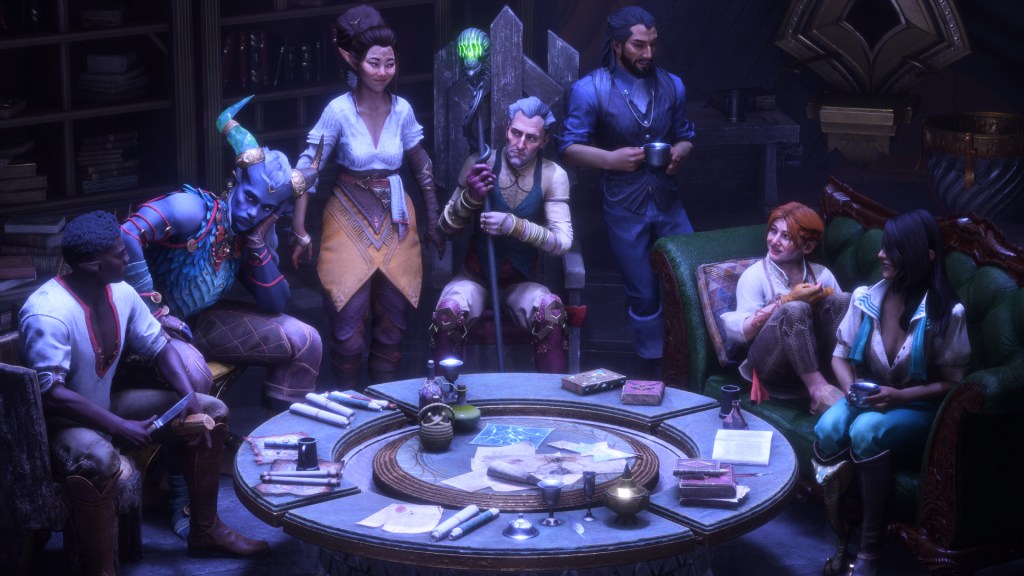
I rarely finish video games. Like books and other projects, I easily succumb to hype, buy new titles, devour the first few hours, then hit a wall—until the next release pricks my ear and I’m calling GameStop about midnight launches. So it’s with genuine triumph that I announce: kicking off 2025, after roughly 90 hours of gameplay, I’ve completed Dragon Age: The Veilguard!
Dragon Age is a fantasy series by developer BioWare about navigating political intrigue, ancient magic, and world-altering conflicts in the world of Thedas. Dragon Age: Origins (2009) introduces the franchise’s core themes of moral choices, consequences, companion relationships (including smooching), and the Blight—a seemingly sentient, mutating miasma of death and corruption. Dragon Age II (2011) tells a more personal tale of a refugee’s rise to power (featuring more companion-smooching). Dragon Age: Inquisition (2014) broadens the scope back to world-saving, fraying tensions between church and state—and smooching companions. Dragon Age: The Veilguard (2024), the fourth installment, is an aftermath tale about stopping an ancient elven god from destroying the world in an act of misguided martyrdom. Oh, and giving your favorite companion a little smooch.
Despite high marks from critics, Dragon Age: The Veilguard was review-bombed early after release by straight white male players for Diversity, Equity, and Inclusion concerns: early gameplay features a predominantly female and racially diverse cohort of competent NPC companions with present-but-unaccentuated breasts. To the surprise and alarm of many, one female-presenting team member named Taash has a skippable questline about discovering and embracing themselves as being nonbinary. If you follow this questline, you will reach a quest where another character misgenders your teammate and the group has a conversation about the importance of pronouns.
Seeing as I’ve finished so few games, it’s only right that I share my thoughts about The Veilguard:
It’s good. You should play it.
The emotional impact of the finale was, in the best way, compromising; I am still reveling in the twists and turns that took place during late gameplay.
While I’ve dabbled in Dragon Age games before, I feel this game is accessible enough on its own to be worth succumbing to hype and devouring a few hours, regardless of prior exposure. The soundtrack, composed by Hans Zimmer, is excellent; combat is a joy; and as someone with ADHD and a propensity to purchase big games and not finish them, I found Veilguard’s structured quest log and narrative progression particularly helpful in maintaining focus and tracking objectives. The game excels in character development and design: I became deeply invested in the protagonist Rook and her slow-burn romance with freckled companion Lace Harding. The emotional impact of the finale was, in the best way, compromising; I am still reveling in the twists and turns that took place during late gameplay.
Deviating from the “correct” path in this game would give Rook a distinct identity and purpose—something that could derail Veilguard’s story from its predetermined path
I do have criticisms for Dragon Age: The Veilguard. BioWare games strive to tell moral stories through player choices and repercussions. To this end, I feel that Veilguard is the most restrictive BioWare game I have ever played. From its start, my Rook was immediately thrust into a predetermined role—chosen to join a team of heroes tasked with preventing the world’s destruction—without any clear explanation why. My Rook could have been anyone, replaced by anyone. I formed my own narrative in my mind explaining Rook’s relationship with the team’s jaunty leader Varric Tethras (informed by my knowledge of him from previous games), but this was never substantiated by anything in-game. The initial premise of working with Varric feels arbitrary rather than a result of player agency or narrative context. I feel that this sense of arbitrary progression persists throughout the game: because I could be anyone, I am not essential to the fate of the world. While Rook’s abilities grow and develop throughout the game, these abilities don’t develop in a way that makes me feel uniquely qualified for the role above any other capable hero in this world. This itself could be an interesting premise for a story, but the game never seems to explore or acknowledge this feeling directly.
Ironically, Rook’s lack of significance becomes a kind of constraint: because Rook could be anyone, the game cannot allow Rook to make truly radical, villainous, or controversial choices. Deviating from the “correct” path in this game would give Rook a distinct identity and purpose—something that could derail Veilguard’s story from its predetermined path. While player choices appear frequently, options often amount to different ways of saying or doing the same thing—varying only in tone rather than substance. Regarding the controversial nonbinary questline, when your teammate Taash balks in conversation and exclaims: “Nobody likes being a woman!” Rook can respond in the following ways:
- “You’re getting there” – encouraging Taash to unpack their feelings
- “We’re here to help” – encouraging Taash to unpack their feelings
- “I need you functional” – encouraging Taash to unpack their feelings
- “Being a woman shouldn’t hurt” – encouraging Taash to unpack their feelings
I love Taash’s character and was excited to support them on their journey. However, while it’s truly refreshing to see such open support for a complex moment of self-discovery in a Western knights-in-armor RPG, the absence of any option to question or challenge Taash turns this encounter into a teaching moment for the player rather than a meaningful interaction that develops Rook’s character or influences their journey. The plot of Veilguard takes precedence over Rook’s agency, hurrying the story forward regardless of either Rook or the player.
The plot of Veilguard takes precedence over Rook’s agency, hurrying the story forward
Finally, there could have been more smooches. Just saying.
Despite these criticisms, I fell in love with Dragon Age: The Veilguard. The game’s representation deserves deeper analysis, and I believe its direct approach to inclusivity marks a significant milestone in major game development. Ultimately, I think that I agree with an online comment I read some time ago that stated this is a good game, but not a BioWare game. Nevertheless, the story’s emotional depth and compelling characters ultimately rival my feelings about player agency—resulting in an unforgettable experience that continues to resonate with me long after the final credits. Also, good on me for finishing a long video game. I’d like to do that more often.

 NPC Dilemma
Leave a comment