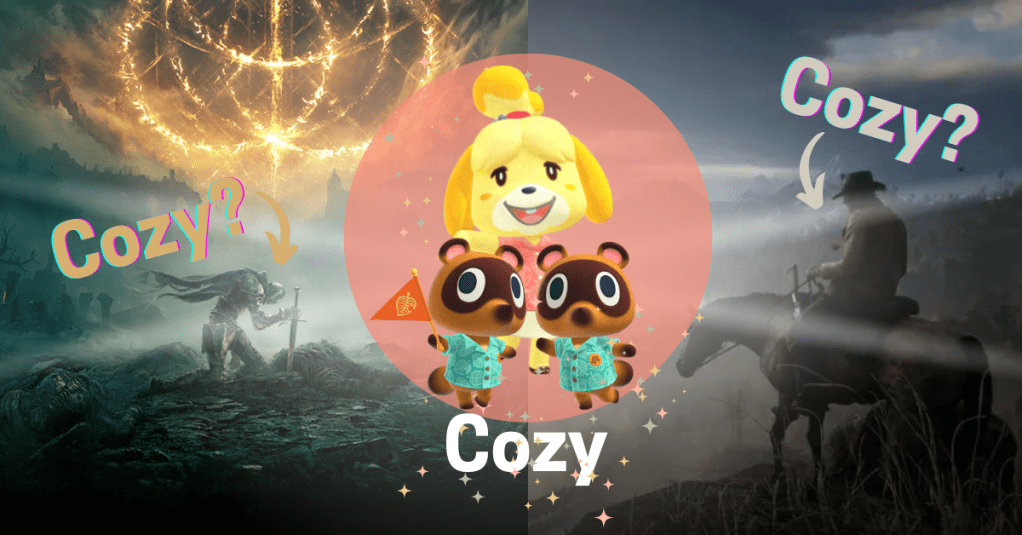
Legitimate question: Beyond the adrenaline and catharsis of horror, can a horror game be considered cozy? How does the games industry define cozy?
Since the last post, I’ve been thinking about what makes “cozy games,” well, cozy. The real world outside, as it’s painted by news headlines and YouTube shorts in 2025, seems to be on fire, and my therapist has strongly recommended I embrace healthy decompression pastimes–such as reading horror and playing dark fantasy games and writing cosmic horror into my dungeons & dragons campaign. (I am sure this is what she meant.)
Legitimate question: Beyond the adrenaline and catharsis of horror, can a horror game be considered cozy? How does the games industry define cozy?
Project Horsehoe (2018)
In 2018, Project Horseshoe, a game development think-tank, put together an 80-page development guide defining “coziness” in game design. Do not fear its terrifying expanse: this document is a fascinating read (that I did not finish in its entirety, who has time for that). In this cozy guide, Project Horseshoe argues that “coziness” is defined by how well a game proposes and maintains “a fantasy of safety, abundance, and softness.”
…
“Coziness” is defined by how well a game proposes and maintains ‘”a fantasy of safety, abundance, and softness.”
Safety requires a player to have the “ability to be vulnerable and expressive without negative ramification”–bonus points if actions are optional, “so that players never feel the threat of coercion.” Abundance recalls Maslow’s Hierarchy of Needs, requiring any cozy game worth its salt to supply all “lower level Maslow needs” (Safety, Hunger, Thirst, Shelter), allowing players to focus on higher-level needs: Mastery, Self-Reflection, and Connectedness. “Cozy games give players space to deal with emotional and social maintenance and growth. Players don’t need to worry about the high stress, immediate trials of mere survival and can instead put their attention towards the delicate work of becoming a better person.” Finally, Softness is an “aesthetic signal” that conveys a low stress environment with obvious access to aforementioned safety and abundance–think music, color palettes, art-style, dialogue, etc.
Safety, abundance, and softness are valuable vocabulary for recognizing coziness in media–but crafting a cozy experience effectively depends on the designer’s ability to understand their audience and create intentional opportunities for mastery that align with their needs. According to Project Horseshoe, “play” provides a safe space for exploring new experiences or developing skills players might not otherwise acquire, while also fulfilling unmet needs. In Red Dead Redemption 2, for example, players can explore a past era of American history and think through survival skills they otherwise would not have. In cozy games, specifically, the audience’s needs shift from avoiding emaciation or navigating violent outlaw politics to creative expression and building relationships. Alternatively, in Animal Crossing: New Horizons, players have creative freedom in decorating their island and home, while building relationships with their villagers and real-life friends. Each game offers a masterclass in immersive “play,” effectively addressing audience needs—yet one frequently and intentionally risks the health of the player character, while the other does not.
Creature Comforts
So far, none of this is boding well for horror games. Horror doesn’t typically give abundance (unless you mean tentacles or gore or something sinister). I suppose it’s not big on giving safety or softness, either. (And if it tried, would we trust it?)
However, this doesn’t mean that coziness isn’t an important part of some horror. Safe spaces, reprieves, familiar objects or environments, and soft atmospheres give players the opportunity to catch their breaths, engage in reflective thoughts or dialogue, and reflect on what truly matters in high-risk scenarios. This abuts Maslow’s higher-level needs. In Dredge, inspired by H.P. Lovecraft, fishing mini games, upgrade menus, and docks are safe and familiar moments for strategy, reflection, and humor. In Dark Souls (Bloodborne, Elden Ring), an oppressively vast, dark, and corrupted world, the recurring image of the bonfire (lamps, lost grace, respectively) becomes a safe haven for the player. In her article “Explore Comfort and Self-Reflection in Cozy Games,” Melissa Brinks writes: “It’s good for pacing, and also for the player’s stress levels–too much stress and they’re likely to quit. The opportunity for quietness and strategy as players level up their characters shifts the tone to one of melancholy and thoughtfulness, appropriate for a world in decay” (2019).
“The opportunity for quietness and strategy as players level up their characters shifts the tone to one of melancholy and thoughtfulness, appropriate for a world in decay”
Melissa Brinks (2019)
Getting Cozy
There are so many cozy-forward games on Valve’s Steam Publisher and in my YouTube algorithm right now. I think it’s easy to see these “cute” and “simple” (looking) games as something frivolous to fill the void. First of all, if true, there is nothing wrong with this. The world is on fire. Support artists. If it is within your means, treat yourself. But more importantly, exploring “cozy” for this post made me reckon with the fact that I have an array of needs outside the game, and for me to feel “cozy,” those needs need tending. The fictional spaces players fill in horror or dark fantasy games may not evoke “cozy,” but on the other side of the screen, horror forces self-reflection unlike any other genre of media. Additionally, referring to my aforementioned dungeons & dragons campaign, I feel confident saying that the anxious uncertainty my players felt navigating a disturbing environment and distressing conversation with a tortured victim of the supernatural taught them more about their characters and ties to one another than rolling dice and fighting the monster. To this end, I believe that horror supports cozy, even if only in contexts adjacent to the game itself.
The fictional spaces players fill in horror or dark fantasy games may not evoke “cozy,” but on the other side of the screen, horror forces self-reflection unlike any other genre of media.
This is a little cheesy to say out loud, but recognizing and understanding coziness in games can help us take better care of ourselves. Assessing whether a game feels “cozy” is ultimately a personal process that requires accepting the existence and reflection of our own needs. Ultimately, while the real world outside often smarts of something abundant in tentacles or gore or something sinister, valuing games that support us in understanding who we are and what we value, or perhaps provide small opportunities for creativity, are healthy for pacing.


 The NPC's Dilemma
Leave a reply to (Not) Becoming an Idle Imp in Fantasy Life i – NPC Dilemma Cancel reply